
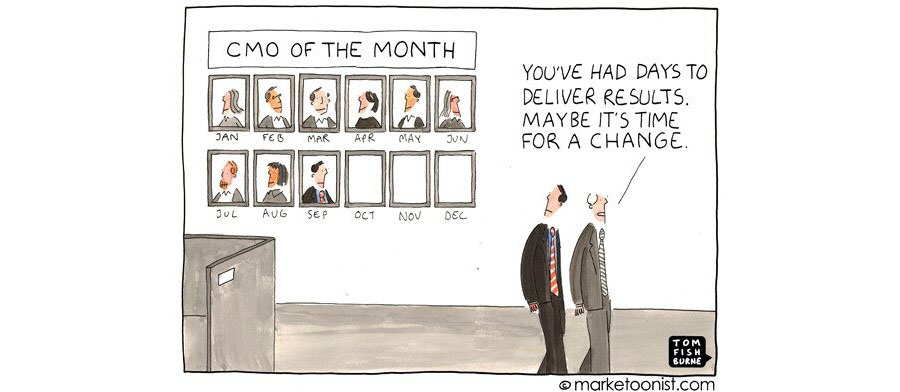
CMO tenure remains shorter than for most C suite roles, but employers have more influence over that pattern than headlines suggest. Companies can reduce avoidable mismatch by defining the business problem, setting a clear mandate, and assessing candidates against the work the role must own.
The 2026 benchmark offers a current starting point for judging short tenure in context. Employers should ask whether the position matched the business need and whether the hiring process tested for that fit from the start.
What the Latest Data Says About Average CMO Tenure
The average CMO tenure was 4.1 years at S&P 500 companies in the 2026 Spencer Stuart study, which is shorter than most C suite roles. Still, a short tenure does not by itself mean the executive or company failed.
This figure is a current benchmark for a specific group of large companies. It is not a universal average for every CMO role. The study year, company group, and definition of the top marketing role all matter when you compare reports.
Context matters just as much as duration. A CMO may leave after a promotion, move into a broader role, or complete a planned succession. As research on short CMO tenure explains, the reason for the departure tells employers more than the length of the tenure alone.
Why Is The Role Of CMO So Different From Other C-Suite Executives?
A CMO title matches the job only when the remit, reporting line, and compensation fit the outcomes the business expects. When those elements conflict, the title can hide a role that candidates cannot evaluate clearly.
CMO backgrounds vary because the mandate changes with the company. An early stage business may need a builder who can create the function. A mature company may need a leader who can scale demand or improve marketing efficiency. Another may need to reposition a brand or guide a major transformation.
That range makes the role different from C suite positions with more consistent paths and operating boundaries. A CMO who performed well in one setting may still be wrong for a different mandate. The question is not whether the candidate is impressive, but whether the candidate has solved the problem this role is designed to own.
CMO Tenure Is Short Due To A Flawed Hiring Process
One reason the average CMO tenure stays short is how employers define and hire the role.
In my role as President of MarketPro, a CMO executive marketing recruitment firm, I have observed the CMO role having the shortest tenure in the C-Suite for about 25 years. There are a few reasons for these statistics, but it basically comes down to the fact that the process that is used to choose the individual who will fill this ultra-critical role is typically flawed.
Reason #1 – The Knowledge Gap
In the vast majority of CMO searches, the individuals conducting the interviews and vetting the candidates do not have the knowledge required to determine if an individual would be a good fit for the role. Marketing candidates are great storytellers, but this does not make them qualified for a CMO position, and most non-marketers are unable to discern the difference.
Unfortunately, most organizations use the same process to hire their CMO as they do for other executive roles, and it looks something like this.
- The CEO is spearheading the hiring process who is not a marketer.
- The HR executive who is great at their role but will not have any experience in marketing.
- A group of peers, such as the CFO or COO, are tasked with helping to vet potential candidates, but these individuals are also non-marketers.
- The partner and senior associate at the executive search firm hired also have no marketing experience. So forget about are we screening appropriately, they do not even understand which candidates they should be interviewing..
The candidates are taken through several rounds of interviews, and not once are they interviewed by someone who knows and understands marketing, let alone the particular expertise needed for the current position.
Reason #2 -They Lack The Knowledge To Identify The Type Of CMO They Need
The pace of change currently going on in marketing is mind-boggling. This makes hiring for a CMO complex, and most companies’ executive teams would not be expected to understand all these changes and how this will impact the necessary background, experience, and track record of the best possible candidates.
Because of the pace of change currently going on in marketing, most senior executives are behind the curve when it comes to data, analytics, performance marketing, attribution and ultimately maximizing ROI. Then you also need a candidate who understands digital, customer experience, brand, etc. All of this factors into the type of candidate you need but who do you have in the interview process who can appropriately assess these qualifications? ,
The type of CMO needed is dependent upon the industry, company size, audience, and company-specific growth goals. If no one in the hiring and vetting process is a marketing expert, how will they know what questions to ask?
The required CMO profile follows the business problem and go to market model. The executive team should define the operating conditions the CMO will inherit and test candidate evidence against that mandate.
The Top Two Issues That Result From This Broken Process
The CMO must have the team, budget, data, and systems needed for the outcomes the company expects. The decisions this leader will control directly must also be clear before interviews begin.
A broken process creates two main problems. Both can damage the search before or after the hire:
- A capable candidate accepts a role whose mandate, resources, or decision rights do not match the expected results. The mismatch may look like a performance problem even when the role was not built to support the work.
- Strong candidates spot unclear ownership, repeated interviews, or conflicting expectations and leave the process before the company can hire them.
Both outcomes carry a business cost. Restarting a senior search takes more time and attention from the leadership team. The company must also rebuild trust among the stakeholders who agreed to the first process.
How Can Organizations Succeed In Hiring The Right CMO The First Time?
Before sourcing begins, define the commercial problem in the context of the company’s stage, market, and growth challenge. Then choose the CMO title and agree on the outcomes that matter in the first 6 and 12 months. Decide what evidence leaders will use to assess progress.
Decide whether the business needs a builder, scaler, optimizer, or transformation leader. Each profile brings a different operating history. Stakeholders should document the agreed role design, assessment criteria, and tradeoffs before meeting candidates.
If the mandate is still unclear, our CMO executive search team can help you frame the decision and the assessment criteria. You can Request Talent to discuss the role and the next steps.
| Business problem | First year outcomes | Authority and resources | Evidence before the search |
|---|---|---|---|
| Build the function | Set strategy, team, and operating rhythm | Hiring authority, core budget, executive access | Examples of building from limited structure |
| Scale growth | Expand proven programs and improve execution | Data access, channel investment, cross functional support | Results from a comparable growth stage |
| Optimize performance | Improve measurement, focus, and resource use | Analytics, finance partnership, change authority | Decisions made from performance evidence |
| Lead transformation | Reset the model and align stakeholders | Executive sponsorship, systems, and broad decision rights | Experience leading complex organizational change |
A Marketing Executive Should Be Interviewed By Expert Marketers
Interview rounds become too many when a stage has no distinct purpose or repeats an earlier assessment. Set the timeline at the start, then give each interviewer a clear question to answer.
Experienced marketers can test how a candidate diagnoses a problem, weighs tradeoffs, and turns strategy into operating choices. They can also tell the difference between a polished story and evidence that fits the mandate.
A structured scorecard keeps that assessment consistent. It should connect each requirement to examples, decisions, and results from the candidate’s work. The interview team can compare evidence against the same criteria instead of rewarding the strongest presentation. A focused process also gives strong candidates a clearer view of the role and how the company makes decisions.
MarketPro Will Guide You Through The CMO Executive Search Process
At least two staff members interview each potential candidate separately. Everyone who works with clients or candidates has prior marketing experience.
Before the search starts, agree on the mandate and which stakeholders will make the hiring decision. Also agree with us on the target candidate market and the criteria used to assess candidates.
Through the MarketPro methodology, we can help your team write interview questions and assess the answers. This support helps each interview focus on evidence that matters for the CMO mandate.
After your interviews and our reference checks, we help you review each finalist’s strengths. Your team makes the hiring decision, and we support the comparison.
Our Expertise Shows
At MarketPro, we focus on marketing executive talent. We have been in business since 1996 and search for candidates across the country. That focus matters when a CMO role requires more than a broad list of executive resumes.
Our team is made up of former marketing executives. We use our marketing expertise to look at the business problem, the operating environment, and the evidence behind each candidate’s experience. Our goal is to give employers a relevant, well assessed group of candidates rather than a generic shortlist.
Good role design and specialist assessment can reduce avoidable mismatch, but no search process can promise a hire or a specific tenure. If you are preparing to hire a CMO, Request Talent and tell us what the business needs this leader to solve. We will walk you through the next steps.